













You might hear the word “ritual” and think holy, or hokey, depending on your position with religion, but ritual doesn’t have to mean that at all. If it makes you feel better about the practice you can switch out ritual for routine. The mechanics are the same, just without the mysticism.
For others, that hint of “holy” might be exactly what you’re looking for to guide your day. Something warm that you can slip into like a loving embrace. A way of entering the day that feels intentional rather than reactive. A guiding light, without the dogma.
Whatever your feeling about the term – ritual or routine – having those regular steps to start your day can help you start, keep you focused, get your creative juices flowing, and maximize your productivity in a way that feels natural vs completely overwhelming.
Before we get started, we should discuss some of the hard rules that you need to protect your creative self without studio time having to feel regimented, like hours at the office or being a retail slave.
Boundaries are crucial and I think you’ll find that they are just as important as inspiration in the studio. That could mean that your phone’s off when you enter your creative space. No favours. No distractions. Or it could mean gentler restrictions. Only one tab open. One project on the table. Sign out of social media. You make a clear agreement about what this time is for and stick with it.
Watch the clock like a feminist and reject productivity theatre while still showing up. Not to rush yourself, but to watch who and what you’re giving your time to. This could mean outsourcing things that want to steal your time to be creative, or letting go of the guilt of telling the kids “not right now”.
And lastly, before we move onto our list, is choosing how you enter the work. Rituals – or routines – can help to accomplish this. Your studio ritual can act as a form of consent. Take a moment before you start to ground yourself. Shift your mindset. And prepare to engage with your creativity.
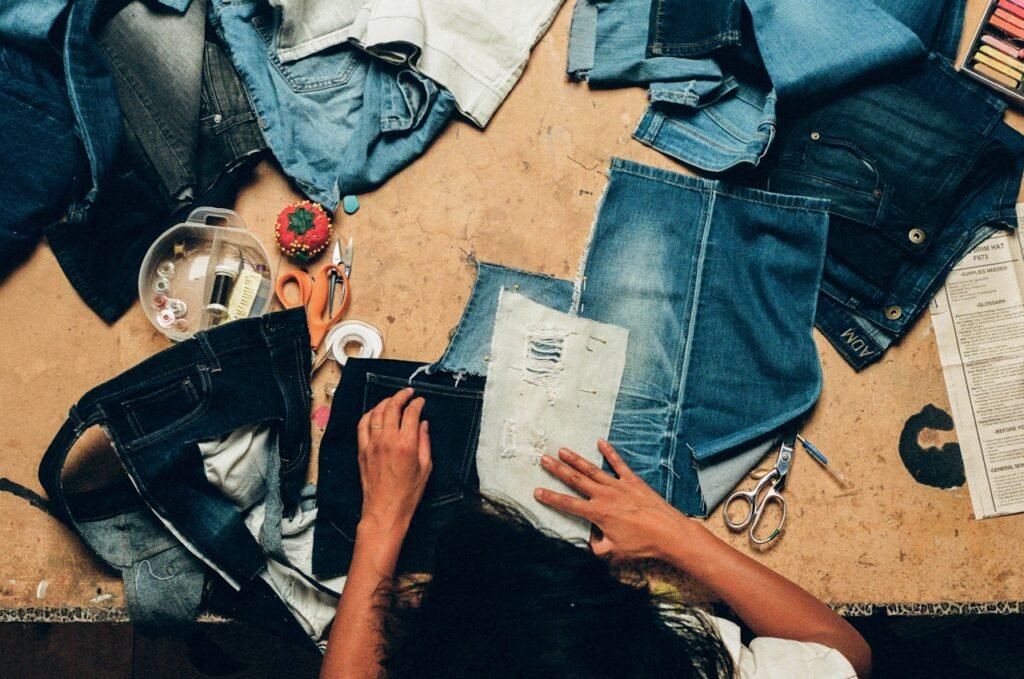
1. The Doorway Pause
This is that extra moment you take to shift gears before entering your creative space. You can add ritual to the moment by touching the doorframe. Closing your eyes
Taking a deep breath.
If that feels like too much, simply pause for a second. Mark the act of crossing the threshold — from the weight of your everyday life into the space where you make things. This is the moment where you transition from domestic, digital, and social labour into creative labour.
A feminist takes this pause at the doorway to lay a line in the sand. While you’re in your creative space you will not tolerate interruptions. Women are interrupted constantly because our time is undervalued, our labour is treated as flexible, and our attention is assumed to be available.
This is true if you occupy a beautiful studio loft space or the corner of your kitchen table. You are valid. Your time has value. And serving yourself is not always selfish.
2. Clear One Surface (Not the Whole Studio)
For some people, clutter can be wildly inspiring. Like a mixed media work of art, just waiting for you to add that next layer. For others, it’s a lead blanket: heavy, suffocating, and capable of stopping you before you even begin.
Whether the clutter releases at a creative storm or clogs the pipes entirely, you’re going to need somewhere to work. Don’t let this be overwhelming when it really doesn’t have to be. Clear one table, mat, or screen. Keep your area tidy so you can at least keep track of your tools and materials. You’ll find the process reduces overwhelm without pretending chaos is the enemy.
Refusal of perfectionism and “aesthetic productivity” is quintessentially feminist. We’re letting go of the false idea that we can all be Marthas (there’s only one Martha) and accepting our work-style as it actually exists.
If you find yourself sliding into a full-studio clean, pause and ask yourself: Do I really need to do this right now — or is this procrastination in disguise?
3. Light the Work Light
Has the sun ever hit you in such a way that it changes everything about the moment? That’s science. Light has a direct correlation on how we feel. Think tropical vacations or a wintertime SAD lamp. It improves our mood, controls our circadian rhythms, and has a huge impact on energy levels.
The type of light you want for your creative space is going to depend on the type of work that you’re doing, as much as the mood you want to set. This might be an ultra white task lamp that illuminates your project or a warm rose coloured bulb to create a cozy and chill atmosphere that you only use for studio time.
Part of the ritual could be the physical action of flipping on and off the switch to mark the start and end of your creative time. Your labour deserves dedicated resources and that includes lighting that helps you to feel focused, comfortable, and supported.
If light isn’t your thing, the ritual physical action could be something as easy as opening a specific tab on your computer. Opening an app that contributes to your work. Or firing up your favourite playlist set to shuffle. The point isn’t the object — it’s the intentional signal that the work has started.
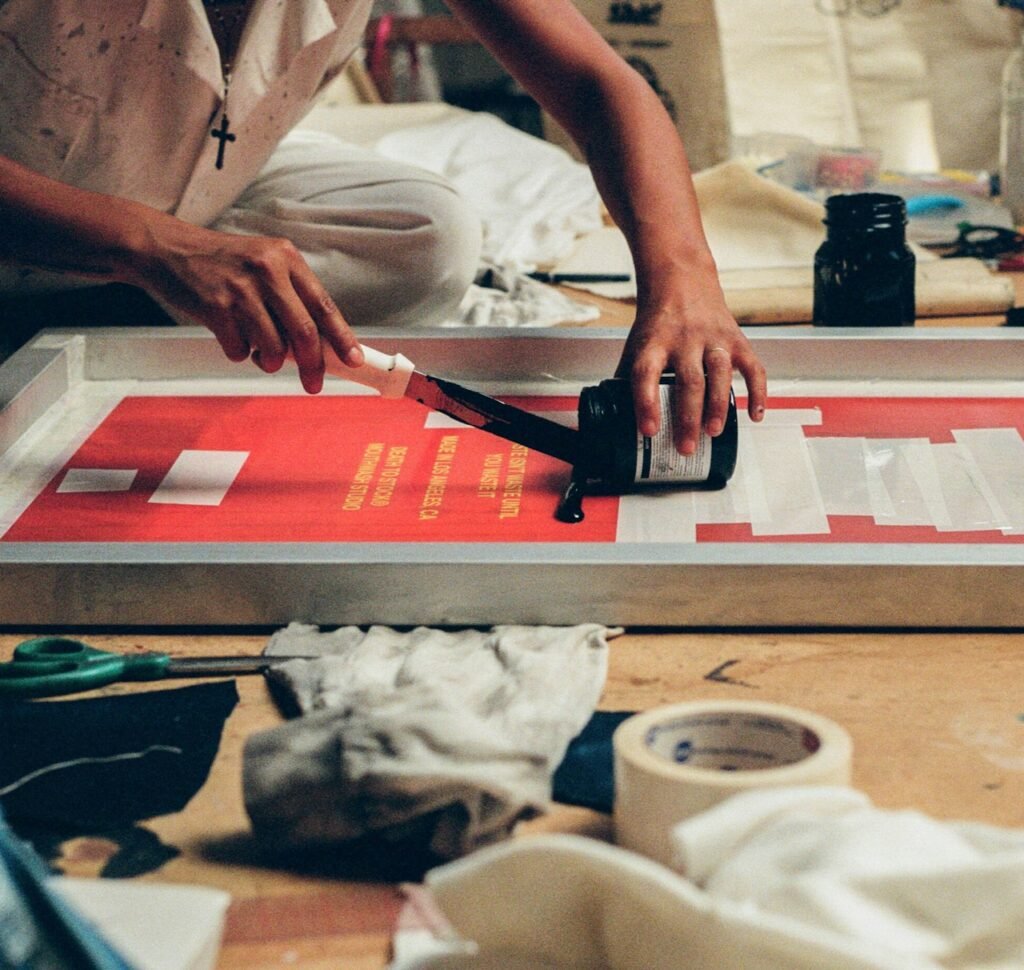
4. The Five-Minute Warm-Up
If you’re anything like me, sitting down at my desk and just “getting to work” is not a thing. That’s why I value my rituals that put me in the state of being that allows me to begin. This includes getting my body involved before my brain starts to panic.
Try five easy minutes of low-stakes making. You could have an old spiral notebook especially for pre-work doodling. Try out a new stitch and knit a swatch (or several). Or my favourite, set aside time to journal before jumping into your creativity. Remember to use a timer so these five easy minutes don’t turn into an hour. It happens.
Most blocks are physical, not conceptual. Honour your skill and muscle memory, not just ideas. Something as simple as shaking the sillies out can make all the difference.
5. Write the Work, Not the To-Do List
When I’m journaling prior to settling into work I focus on only writing about my studio time. All the entries about your boss being an asshole or that thing that dude said that got under your skin come long before or after this time of creative productivity. Unless the asshole or the dude are inspiration for what you’re working on, they’ll just end up spoiling the mood.
Try writing just one sentence: What am I actually making today? This will help to anchor the session to creation and not admin. Leave your journal open to the page where you set your intention. Creative labour is not a side quest and this activity will help you stay focused. If you feel your brain starting to drift, read that one sentence again. It’s often enough to bring you back.
6. Revisit a Line You Love
Everyone has a favourite quote. You probably have one for just about every occasion. Try reading one line from a book, zine, lyric, or note you keep nearby and reconnect to why the words are important to you. Why do they land the way they do? Who wrote them, and what did they mean in that moment?
Lineage matters. We don’t create in isolation, even when we work alone. Sometimes encountering someone else’s words or art is enough to remind you that you’re not the first to feel this way — and not the only one still trying to make something out of it. Returning to other people’s work can help you reconnect with the why behind your own.
If you don’t have a quote or passage that particularly stands out to you, try writing your own studio canon. Embroider it onto a pillow. Screen it onto a banner. Say it out loud when you enter your studio. Words matter — especially the ones you choose to carry with you.
7. Touch Your Tools with Intention
Before you begin, physically pick up the main tool you’ll be using today. Hold it for a moment. You don’t have to use it right away — just acknowledge it. This small action signals commitment without pressure. You’re not demanding output; you’re setting direction.
From a feminist perspective, tools are extensions of agency. They’re how ideas move from the body into the world. Touching your tools is a way of claiming that agency before anyone else gets a say in how your time or attention should be used.
This counts even if the tool doesn’t get used immediately. The act itself matters. You’ve chosen the work. The work knows you’re here.

8. Set a Boundary Before You Begin
We touched on boundaries at the beginning of this piece, but they matter enough to come back to. Boundaries protect creative attention and help reject the expectation of constant availability — especially if you’re the kind of person who does a little bit of everything for whoever asks.
That version of generosity might sound good in theory, but it isn’t sustainable unless doing things for other people is literally your job. Creative work requires attention, continuity, and limits. Boundaries aren’t selfish. They’re how the work survives.
And if setting boundaries makes you uncomfortable, try to set temporary ones. Decide what won’t be happening during this creative session. No emails. No social media. No errands. This time is especially for you. Even temporary boundaries are valid.
9. Name the Energy of the Day
In my work with She Zine, I use themes to set the tone for a day, a week, or even a full month of work and creative play. Themes help maintain focus and guide our content so it lives somewhere along a shared thread. They function like a roadmap — one that’s had a real impact on my productivity — while also creating a more cohesive experience for readers. A theme lets people slip into the work and move from post to post without being jolted out of it.
A theme can be as simple as a single word: slow, chaotic, tender, loud.
Don’t expect revelation on day one. Setting a theme is about aligning expectations with reality. It requires rejecting the myth of uniform productivity and resisting the urge to compare yourself to other creators who appear to be operating on a different level. They hit snags too — even if you don’t see them.
Different energies still produce real work.
10. Begin Imperfectly, On Purpose
Finally, experiment with starting before you’re actually feeling ready. Even if you make this a part of your routine one day a week. Enter your studio with ritual and intention, sit down, and go for it. This might break the spell of the overthinking that’s paralyzing you.
Perfection has been used to silence women forever. We’re taught to wait until we’re fully prepared, fully qualified, fully confident. Don’t bother until the work is flawless and the conditions are ideal. That delay isn’t neutral. It keeps ideas private, unfinished, and safely out of the way. Starting imperfectly is not a failure of discipline; it’s an act of resistance. Making something before you’re “ready” is often the only way the work ever gets made at all.
And sometimes, the ritual isn’t even the point – starting is.

Rituals Are Tools, Not Rules
Take this list as a set of suggestions, not a hard how-to. Use what works. Adapt anything you need. Throw out what doesn’t (truly — forget I ever said it).
What matters most is sustainability. The goal isn’t to build another system you have to force yourself to follow, but to develop rituals you can rely on — ones that support your workflow instead of becoming another obstacle to making.
You want entering your studio, or creative space, to feel steady and nurturing, not fraught or performative. Don’t force what doesn’t feel natural or productive. Studio life is a long game. It’s not a performance.
What helps you cross the threshold into the work? Share your ritual hacks and tips in the comments!
→ Want more content like this? Subscribe to The Edit — our weekly(ish) newsletter.
→ Have something to say? Pitch your ideas to She Zine Mag.
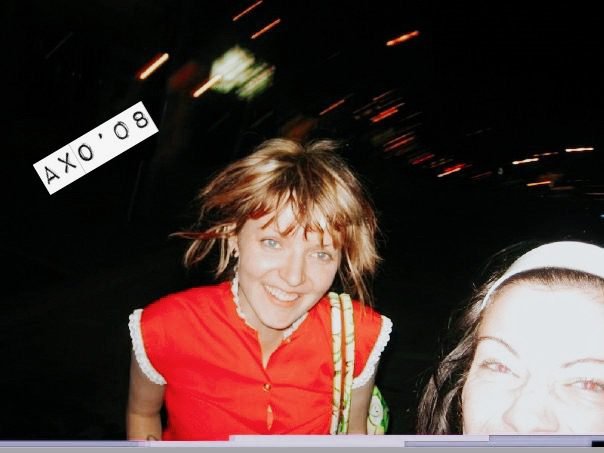
AXO (she/her) is a multidisciplinary creator, editor, and builder of feminist media ecosystems based in Toronto. She is the founder of She Zine Mag, Side Project Distro, BBLGM Club, and several other projects under the AXO&Co umbrella — each rooted in DIY culture, creative rebellion, and community care. Her work explores the intersection of craft, technology, and consciousness, with an emphasis on handmade ethics, neurodivergent creativity, and the politics of making. She is an advocate for accessible creativity and the power of small-scale cultural production to spark social change. Her practice merges punk, print, and digital media while refusing to separate the emotional from the practical. Above all, her work invites others to build creative lives that are thoughtful, defiant, and deeply handmade.