














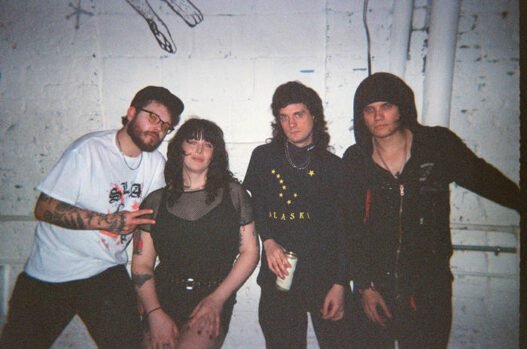
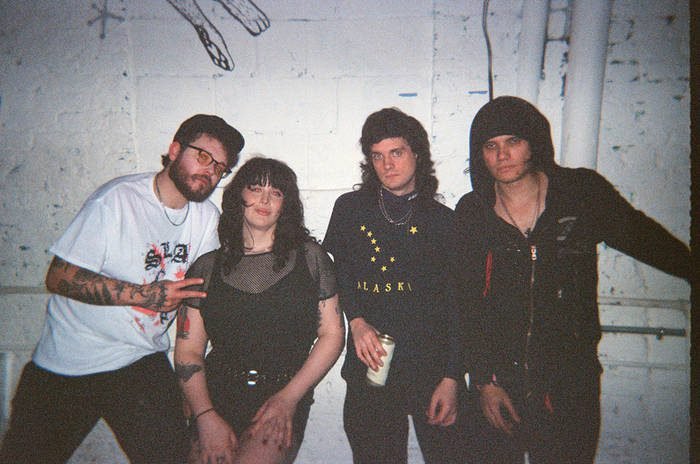
From the first moment you encounter the name, there’s a provocation at work. Not shock for shock’s sake, but an insistence on interrogating what we flinch from, what we dismiss, and what we’re taught to keep quiet. PILLOWBITER’s music is heavy, fast, and furious, but the real weight lives underneath: questions about anger, gender, survival, punk ethics, and what it means to make space for people who are routinely pushed out of it.
In this conversation, front woman Sasha talks candidly about reclaiming (or undermining) language and why punk is less about subgenre purity and more about values. She reflects on anger as something necessary rather than dangerous, on shows as sites of care as well as chaos, and on the responsibility artists carry when their work resonates with lived pain.
This isn’t a manifesto. It’s a clear-eyed look at what it means to make music in a moment that demands honesty, accountability, and a willingness to feel everything—joyfully and loudly.
SZ: You’ve talked about reclaiming slurs through the name PILLOWBITER — has your relationship to that reclamation shifted as the band has grown?
PB: Well, maybe it’s less “reclaiming” a slur so much as it is undermining its original meaning. I’m not necessarily asking people to go around calling themselves “pillow biters.” I’m merely inviting people to reconsider the association of the pejorative. Other bands have done a similar thing (Limp Wrist, The Chinkees) so I think of it as a sort of tradition in the genre. What I like about the name is that it immediately piques your curiosity. It makes you ask why would a band name themselves that, which in turn makes you pay closer attention to the message. It did take some discussion among us to commit to the name, but I’m happy we landed where we did. My only concern with it being our band name is whether it may create a creative limitation. Will I want to hang my hat on this subject matter for a band long term? Probably so, since it’s such a personal matter to me. But ultimately, it probably won’t make much of a difference either way.
SZ: Tell us a little bit about The Beautiful Child. Looking back, what do you think that project taught you that made PILLOWBITER possible?
PB: I don’t have much to say about The Beautiful Child. It was just me wanting to start a new band and exploring new musical directions. I didn’t have anyone to collaborate with at the time, so I figured, fuck it, I’ll just do it alone and see what happens. But music is fundamentally a group project, even if you’re a solo artist. So as soon as the opportunity came to play with other people, I went for it.
SZ: Do you ever hear echoes of TBC in PILLOWBITER, or does it feel like a clean break?
PB: I’m proud of the songs I wrote back then, but I’ve definitely moved on creatively. We know how to play a few of those old songs, and I’d love to get around to recording them with the band just for fun, but my priority is writing new songs with the PILLOWBITER concept in mind.
SZ: You’ve talked about learning to let go of ideas that don’t fit the band. How do you recognize when a song does belong?
PB: I mean, as long as it kicks ass, haha. I’m only partly kidding. I have so many influences, in heavy music and beyond, that I find myself playing around with ideas that sound like death metal or mathcore or thrash or whatever. So I’m open to taking the band in a variety of directions, but honestly I just follow my instincts. Does every part of the song satisfy me? If I can answer that question with a yes, then it makes it through. There’s no harm in revision, and as I write and revise, I may take a kind of mid song and make it great. But if it doesn’t lead anywhere, that’s okay too, and I don’t feel bad for letting it go.
SZ: You’ve said “punk” matters more to you than subgenre accuracy — what does punk actually mean to you right now?
PB: It’s an ethos, isn’t it? It’s anticapitalist, it’s egalitarian, it’s anti-status quo. It’s more than a genre or a sound. Think of all the bands that are called punk. That’s a whole universe of styles. But any band that sounds “punk” but doesn’t stand for the values I think is pretty full of it.
SZ: Is there freedom in being hard to categorize, or does it ever feel limiting in scenes that like neat boxes?
PB: Hm, I don’t know. I think it will serve the band in the long run because it’ll stay interesting to me for longer (and hopefully to listeners too). I’m happy to let the world decide what category we belong to, because I kind of don’t care much. We have an inside joke in the band. Lachlan calls us a grindcore band, and I always reply with a lengthy, convoluted clarification. “Well, actually we’re a crust-influenced mathcore d-beat powerviolence band” or something like that, haha. Commence the eye rolls. But if people say we’re a grindcore band or powerviolence band or something else, that’s cool with me.
SZ: You’ve said the band exists to make space for anger — what does healthy anger look like to you?
PB: I don’t really want to oversell this idea as the “point” of the band. It’s more of a product of the message, or of the conditions under which we live. The point of the band (beyond simply being a very necessary creative outlet) is to raise awareness for trans/queer perspectives. A lot of that subject matter can make a person angry, and rightfully so, because discourse around transness is rife with issues. The injustice of it all should makeyou angry. It is a perfectly reasonable reaction to a world that wants to write you out of existence.
A quote from Che Guevara comes to mind: “If you tremble with indignation at every injustice, then you are a comrade of mine.” With that in mind, I guess you could say that healthy anger is a symbol of optimism and hope. It insists that a better world is possible and that we should strive to achieve it. There are many concrete, practical ways to work towards accomplishing that goal: mutual aid, activism, agitprop, etc. Art and music play a vital role as well. To find the time to dance, to make and share music with like-minded people, and to build community around art, these are essential human experiences. So we can and should be doing the work that our values demand, but we can also create occasions for self-expression at the same time. It just so happens that the particulars of my creativity revolve around heavy, “angry” music.
SZ: What does it mean to reclaim anger as something feminine, trans, or sacred?
PB: I think every woman, cis or trans, can relate to the feeling that her anger is not allowed or is somehow “unwomanly.” This is par for the course under patriarchy. To have our emotions policed is to reify our subjugation. And so to defy the social conditioning that insists on docile women is to defy our subjugation. In this way, “anger” (or more accurately, resistance) becomes a kind of epitome of womanhood.
SZ: Has performing these songs changed how you hold your own pain offstage?
PB: I’ve definitely released a lot of my own pain this way, because that is a natural outcome of self-expression. Music heals the soul. Performance is therapeutic. An artist feels an imperative to create. If I don’t create, I will suffer for it. It doesn’t matter what it is I’m creating. There’s nothing essential to this band that makes it a “pain-outlet.” If we were a disco band, the release would be the same. The practice of creation is itself the release.
SZ: When you write about violence or dysphoria, what responsibility do you feel toward listeners who share those experiences?
PB: The only thing I can do is be honest about my experience and hope that it resonates with people. It’s very easy to think you’re alone in those feelings, but you’re not. I don’t want anyone to suffer in silence. So maybe it’s just about setting an example, trying to be brave and to talk about difficult things, and make someone feel understood along the way.
SZ: You’ve talked about shows as places of care as much as chaos. What makes a space feel genuinely safe to you?
PB: To be frank, if there are plenty of women there, in the audience or on the stage. It’s no secret that hardcore scenes can be like boys’ clubs. If there are no bands with women or people of color or queers or anything like that, it strikes me as a bit concerning. I’m sure a lot of well meaning cis straight white dudes end up booking bills that are just them and their identical buddies, no malice intended. But that kind of oversight signals to me that inclusion isn’t an explicit priority in that scene. That being said, I feel blessed with our particular scene. I always feel welcomed, and I know the band’s message is appreciated. So I’m grateful.
I also like when shows are all ages, because a lot of times it’s the kids who need the space the most. I remember being an isolated teenager, just dying to be old enough to start going to see bands that I loved, and to start playing venues that were 21+. I know what it feels like to need that connection, to feel less weird, less of an outsider. So when kids can take part, are welcomed, and nurtured without judgment, that’s a sign of a healthy scene.
Lastly, I’ll say that as much as I love the pit and people losing their minds and raging out and stuff, I also like to see responsible and considerate movement. Just recently I had a good friend take a massive hit in the pit, and no one seemed to give a shit. No hand came to help pick them up. Just stares. This person isn’t exactly huge, so when a 200-pound guy slammed into them, it really rattled them, so much so that they left the show. Fuck that. If showing off your moves and your “strength” in the pit matters more than even noticing you caused harm, then you’re doing it wrong.
SZ: How do you think accountability should function in punk scenes — beyond callouts?
PB: I don’t know about callouts. I’m not really trying to put anyone on trial. But there’s definitely a way to draw attention to unwanted behavior and to call for correction without making that person into a pariah. I think a band has a responsibility to keep an eye out in the audience and take note when something is off, and to point it out from a place of love. We live in a society of discontent and social ills. The symptoms of living in that world will inevitably bleed into a music scene, even though we aim to prevent that. But when it does, let’s remember that all of us are carrying wounds. I think punk scenes should welcome that kind of healing. There are limits of course, because we should not and absolutely will not shelter abusers or racists or the like. But a lot of times there is drama when all parties involved are well-meaning. Grace is good.
SZ: What does solidarity look like in practice, not just in language?
PB: There are plenty of roles to play in whatever causes you believe in. Not everyone has to be on the front lines, as it were. I encourage people to explore, to figure out what their strengths are, and to lean into them in a way that can benefit their communities, or individuals, or whatever. Find out what feels good to you to offer the world, and make a commitment to providing it.
SZ: Have you seen the scene change in how it supports trans musicians, or is it still uneven?
PB: To be fair, there are just far fewer trans people in the world than cis. So unevenness is kind of a statistical guarantee. But I guess I would like to see more trans members in bands. And for bands with cis members to speak up for the queer community when it’s called for. But in general, the punk scene is a great place to be trans.
SZ: You often pause mid-set to speak directly to the crowd. What do those moments give you that music alone can’t?
PB: When you have a platform, no matter how small, it’s good to be clear about what your values are. Where we are at as a band right now, almost everyone in the audience is probably hearing us for the first time. So if that’s the only experience you ever get of the band, I like to provide a little bit of context about what it is we are doing. And hopefully get people energized and excited about the set at the same time.
SZ: You’ve mentioned longer and more complex songs on the upcoming LP — what pushed you in that direction?
PB: Nothing in particular. I think it’s just the natural growth of the band as we continue to write new songs. Plenty of the new stuff is quick and dead simple, like our first EP. But we also welcomed the instinct to linger where it made sense. I think if anything, the newer songs paint a fuller picture of who PILLOWBITER is and what our sound is. I’m very excited to get to work on it and share with people.
SZ: How are you thinking about pacing and emotional flow across a full record?
PB: That kind of sorts itself out. You have a batch of songs and you arrange them in a pleasing order. You just feel it.
SZ: Does the album have a thematic spine, even if it’s not a concept record?
PB: Yeah, I suppose so. A lot of the lyrics are about the emotional state I’ve ended up in, dealing with life as a trans woman. The hopelessness, the anger, the fear, and the perseverance. It’s all very personal. I’ve wrapped a lot of intimate details inside a very fiery set of songs, which if you know me, is pretty emblematic of who I am. I’m a big feeler, but it comes with a bite. My defensiveness is also my self-preservation. My survival is raw. I think that comes through pretty clearly on the album.
SZ: What risks are you excited to take this time that you didn’t on the EP?
PB: Hm, I wouldn’t think of anything as risks, per se. But I’m excited to make an album that’s a bit more crafted and well-produced. And to give it our best shot to promote. So hopefully a tour, a video, and other new stuff will be following.
SZ: What do you want listeners to sit with after hearing the album front to back?
PB: I mean, it would be great if people pay attention to the lyrics and gain something from that. But I also just hope people like the sound.
SZ: You’ve said success isn’t really the point — but what does sustainability look like to you?
PB: I’m old enough now to know that I can’t help but do this kind of thing. To be me is to be a woman who makes music. I can only hope that people want to listen and that I remain capable of playing and performing for as long as possible.
SZ: Who do you want to shout out — bands, organizers, spaces, or people holding things together quietly?
PB: Shout out to AJ Tobey, who put our EP. Shout out to everyone who has booked us, or listened to us, or bought merch, or been to a show, and to all of the bands we’ve played with or will be playing with. And thank you for the opportunity to talk about the band in more detail!
SZ: What’s next that you’re excited about right now?
PB: Getting back to the studio. Stay tuned.
With a new LP on the horizon and a clear commitment to growth without compromise, PILLOWBITER is building something sustainable—not by chasing success, but by staying rooted in purpose.
Support the band by following their links!
Instagram: @pillowbiterhc
bandcamp: PILLOWBITER crew
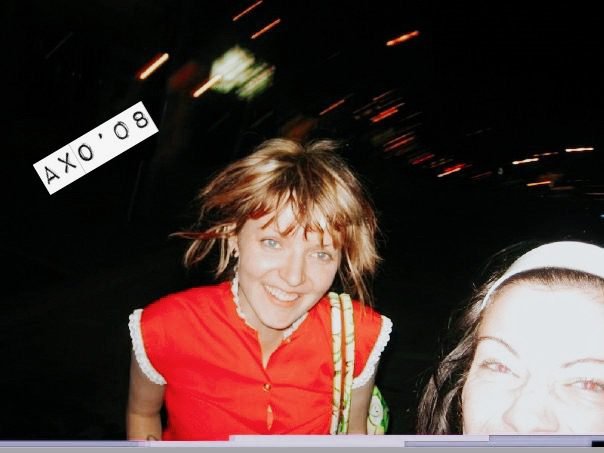
AXO (she/her) is a multidisciplinary creator and editor based in Toronto. She is the founder of She Zine Mag, Side Project Distro, BBLGM Club, and several other projects under the AXO&Co umbrella — each rooted in DIY culture, creative rebellion, and community care. Her work explores the intersection of craft, technology, and consciousness, with an emphasis on handmade ethics, neurodivergent creativity, and the politics of making. She is an advocate for accessible creativity and the power of small-scale cultural production to spark social change. Her practice merges punk, print, and digital media while refusing to separate the emotional from the practical. Above all, her work invites others to build creative lives that are thoughtful, defiant, and deeply handmade.