














At some point over the last decade, self-improvement stopped being a category of books and became its own aesthetic.
Advice that once lived on the impulse-buy shelves of airport bookstores now appears everywhere. Open Instagram and somebody is explaining how to optimize your morning routine. Open YouTube and you’ll find a stranger describing the habits that transformed their life. Browse a few articles online and before long you’re being encouraged to turn your hobbies into income streams, your interests into personal brands, and your spare time into a resource that should be managed more effectively.
None of this advice is necessarily bad. Drinking water is good. Exercise is good. Having goals = good.
What feels different is the assumption lurking beneath it all: that every aspect of life should be moving toward a more productive, efficient, and successful version of yourself.
The ideal modern citizen isn’t simply happy or fulfilled. They’re optimized.
They’re expected to be constantly improving, learning, refining themselves. Even leisure has become performative. Reading is no longer something you do because you’re curious about a subject. It becomes part of a challenge, a goal, or a public record. A creative hobby is encouraged not because making things is enjoyable, but because it might eventually become a business. Activities that once existed purely for pleasure are increasingly expected to justify themselves through productivity.
I consume and participate in content like this all the time, but at some point the question must be asked, is all of this effort is actually making life more meaningful?
We’ve become remarkably good at measuring progress. Apps are great. We can track our sleep, monitor our exercise, organize our goals, count our steps, and analyze our habits. Yet many people still feel exhausted, distracted, and vaguely dissatisfied, as though self-improvement has become another obligation added to an already impossible to-do list.
Part of the problem may be that self-improvement culture quietly assumes the source of every problem is the individual.
Feeling lonely? Work on yourself.
Feeling anxious? Improve your habits.
Struggling financially? Start a side hustle.
Burned out? Develop a better routine.
The proposed solution almost always involves personal adjustment. Makes sense, right? But what gets lost in that framework is the possibility that some problems aren’t personal failures at all.
Loneliness might have something to do with the disappearance of community spaces. Burnout might have something to do with jobs that demand more while paying less. Housing insecurity might have something to do with housing costs. Not every frustration is evidence that you’ve failed to optimize yourself properly.
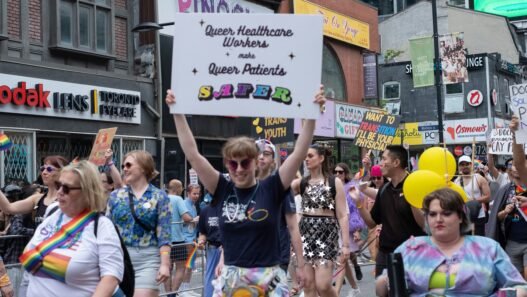
And maybe that’s where Pride and punk enter the conversation in an unexpected way.
Not because either movement rejected growth or personal change. They clearly didn’t. But because both emerged from communities that understood something we’ve started to forget: a meaningful life and an efficient life are not necessarily the same thing.
For decades, queer people were told that acceptance could be achieved through self-improvement. Be quieter. Be more respectable. Blend in. Adjust your behaviour. Modify yourself until the world finds you acceptable.
The queer liberation movement challenged that logic entirely.
Instead of asking how queer people could change themselves, activists began asking why society demanded those changes in the first place.
Punk culture arrived at a similar conclusion from a different direction. It questioned institutions, expectations, and conventional ideas about success. It wasn’t particularly interested in helping people become more efficient versions of themselves. If anything, it often mocked the assumption that every life should follow the same approved script.
Both traditions contain a useful reminder for the present moment. And that is that not every problem is a personal project. Not every challenge can be solved with a better planner, a more disciplined routine, or an app.
Some problems belong to institutions, governments, workplaces, and to culture itself.
That’s not an argument against personal responsibility. It’s simply an argument for perspective.
Because once you start viewing every difficulty as a failure of self-management, life becomes an endless improvement project. There is always another habit to develop, another goal to pursue, another version of yourself waiting somewhere in the future.
You never arrive.
You simply continue optimizing.
One of the things I find most refreshing about creative communities, queer spaces, and punk culture is their refusal to measure value exclusively through productivity. These worlds are filled with people pursuing interests that make very little sense from an efficiency standpoint. People spend years documenting local music scenes, researching obscure histories, collecting forgotten ephemera, learning difficult skills, and creating projects that the world may never see.
They do these things because they’re fascinated.
Because they care.
Because the activity itself feels worthwhile.
That kind of motivation feels increasingly rare.
We live in a culture that constantly asks what we’ll gain from our efforts. What opportunities will emerge? How will this advance our goals?
They’re reasonable questions.
They’re just not the only questions.
Sometimes the better question is whether something makes life more interesting.
Whether it deepens our understanding of the world.
Whether it connects us to other people.
Whether it gives us a reason to get excited about an otherwise ordinary Tuesday.
Pride, at its best, has always celebrated people who refused to live according to somebody else’s definition of success. Punk has always celebrated people who created things before they had permission, credentials, or a business plan.
Both traditions contain a quiet reminder that life is about more than optimization. Perhaps not every aspect of ourselves requires improvement? Sometimes it is enough to care deeply about something, spend time with it, and allow it to become part of the story of who we are.
That may not qualify as self-improvement.
But it might be a far more satisfying way to live.

AXO (she/her) is a multidisciplinary creator and editor based in Toronto. She is the founder of She Zine Mag, Side Project Distro, BBLGM Club, and several other projects under the AXO&Co umbrella — each rooted in DIY culture, creative rebellion, and community care. Her work explores the intersection of craft, technology, and consciousness, with an emphasis on handmade ethics, neurodivergent creativity, and the politics of making. She is an advocate for accessible creativity and the power of small-scale cultural production to spark social change. Her practice merges punk, print, and digital media while refusing to separate the emotional from the practical. Above all, her work invites others to build creative lives that are thoughtful, defiant, and deeply handmade.